
Equine Red Light Therapy for Tendons, Ligaments & Injury Recovery
Tendon and ligament injuries are among the most challenging soft-tissue injuries horse owners can face. Whether your horse is recovering from a superficial digital flexor tendon injury, suspensory ligament damage or another soft-tissue condition, rehabilitation often requires patience, careful management and veterinary supervision.
As interest in equine rehabilitation continues to grow, red light therapy and photobiomodulation (PBM) are increasingly being explored as complementary approaches to supporting equine wellness.
But can red light therapy actually help injured tendons and ligaments? What does scientific research tell us, and how do LED therapy pads compare with handheld therapeutic lasers?
In this guide, we'll explore how light therapy works, what current research suggests and how it may fit into a veterinarian-guided equine rehabilitation program.
Understanding Tendon and Ligament Injuries in Horses
Tendons connect muscles to bones, while ligaments connect bones and help stabilize joints and other structures.
Both are essential for supporting a horse's movement, stability and athletic performance.
Common equine soft-tissue injuries include:
-
Superficial digital flexor tendon (SDFT) injuries: Often associated with athletic activity and repetitive loading.
-
Deep digital flexor tendon (DDFT) injuries: Can affect different regions of the limb, including structures within the hoof.
-
Suspensory ligament injuries: May involve the body, branches or proximal portion of the suspensory ligament.
-
Check ligament injuries: Can occur in performance and recreational horses.
-
Other soft-tissue strains: May affect supporting structures around joints and limbs.
Signs of injury can include swelling, heat, sensitivity, lameness or changes in performance.
However, some significant injuries produce surprisingly subtle symptoms.
Veterinary examination and diagnostic imaging, particularly ultrasound or MRI where appropriate, are important for identifying the affected structure and determining the extent of damage.
Why Tendon and Ligament Recovery Takes Time
Tendons and ligaments are highly organized connective tissues that must withstand substantial mechanical forces.
When injured, the body begins a repair process involving inflammation, cellular activity, collagen production and tissue remodelling.
Unfortunately, newly repaired tissue does not immediately possess the strength or organization of healthy tissue.
Rehabilitation therefore involves more than simply reducing swelling or discomfort.
A successful recovery program generally aims to restore tissue function while carefully managing mechanical loading.
Depending on the injury, a veterinarian may recommend:
-
Controlled exercise and gradual loading
-
Periodic ultrasound examinations
-
Appropriate rest and turnout management
-
Hoof balance and farriery adjustments
-
Additional veterinary treatments when indicated
-
Complementary rehabilitation therapies
Reducing pain does not necessarily mean an injured tendon or ligament has regained its original strength.
This distinction is particularly important when considering light-based therapies.
What Is Equine Red Light Therapy?
Red light therapy is a form of photobiomodulation, a process in which specific wavelengths of light interact with biological tissues.
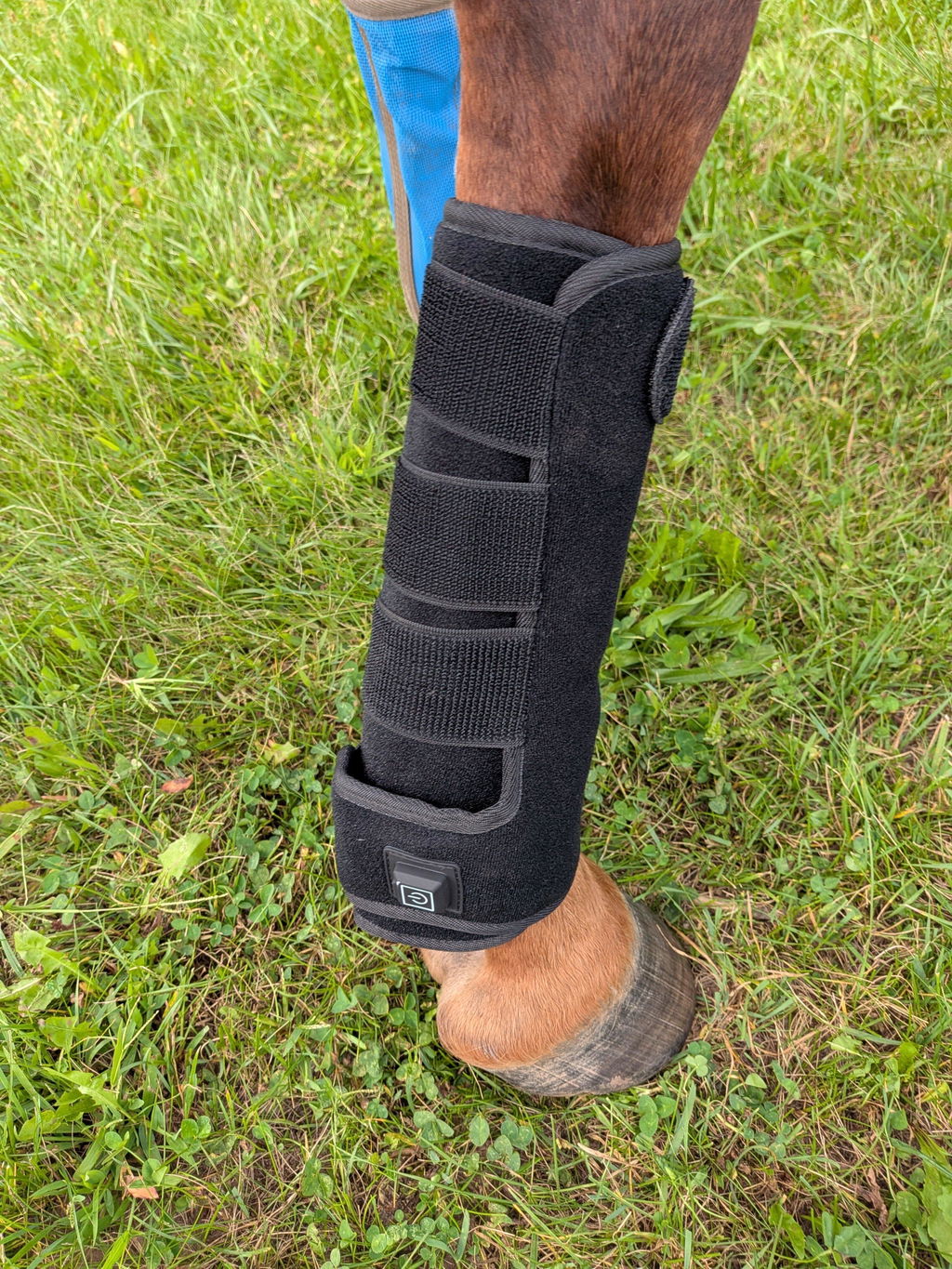
Equine LED therapy pads commonly combine visible red light with near-infrared light.
Two frequently used wavelengths are:
660 nm red light
Visible red light is commonly used in photobiomodulation applications involving the skin and relatively superficial tissues.
850 nm near-infrared light
Near-infrared light can penetrate more deeply than visible red light under certain conditions, although the amount reaching a particular structure depends on the tissue, device and treatment setup.
Photobiomodulation research investigates how light exposure may influence cellular signalling, inflammatory processes and tissue repair.
However, biological effects observed in laboratory studies do not automatically establish that a particular device can accelerate healing of an injured equine tendon.
Can Red Light Therapy Help Horse Tendon Injuries?
This is an important question, and the answer requires distinguishing between different types of light therapy.
Researchers have investigated therapeutic lasers for equine tendon and ligament injuries, with some encouraging findings.
For example, a 2020 study published in Animals examined high-intensity laser therapy in 26 horses with tendon and ligament injuries.
The researchers reported improvements in several clinical measures, including pain, swelling and lameness, as well as changes in ultrasound-assessed lesion size.
These findings suggest that certain therapeutic laser approaches may have value as complementary rehabilitation treatments.
However, the study used high-intensity laser therapy, not a standard consumer LED therapy pad.
Its findings therefore cannot be directly applied to every red light therapy product.
Similarly, research into high-power laser therapy for suspensory ligament injuries has reported encouraging imaging and tissue-repair findings.
A 2025 veterinary review discussed potential benefits of high-power laser therapy while emphasizing the need for better-established treatment doses, protocols and long-term clinical outcomes.
The key takeaway: Therapeutic light remains an active area of equine rehabilitation research, but there is currently insufficient evidence to claim that ordinary LED pads reliably accelerate healing of equine tendon or ligament injuries.
LED Therapy Pads vs Handheld Cold Lasers
Although LED pads and therapeutic lasers can use similar wavelengths, their light delivery differs.
LED Red Light Therapy Pads
LED therapy pads use multiple light-emitting diodes distributed across a flexible surface.
They are particularly convenient for:
-
Covering relatively broad treatment areas
-
Incorporating light therapy into general wellness routines
-
Supporting comfortable, hands-free application
-
Use around suitable anatomical regions where the pad fits correctly
Wireless LED pads can be especially practical for owners managing multiple horses or incorporating light therapy into everyday care.
Handheld Class 3B Cold Lasers
Class 3B therapeutic lasers deliver laser light through a more concentrated treatment head.
Depending on their specifications, these devices may be useful when a trained user requires a more targeted application.
However, Class 3B lasers should not be confused with the higher-powered Class IV lasers used in several published equine tendon and ligament studies.
Different devices deliver different amounts of energy, and treatment results cannot be assumed to be equivalent.
Laser eye safety, appropriate technique and veterinary guidance are important considerations.
For a more detailed comparison, read:
Red Light Therapy vs Cold Laser Therapy for Horses: What's the Difference?
Where Might Red Light Therapy Fit Into Equine Rehabilitation?
Light therapy is best considered a possible complementary component of a broader rehabilitation program rather than a replacement for established veterinary treatment.
For example, an owner may wish to discuss light therapy with their veterinarian during a recovery program involving:
Tendon rehabilitation: Where carefully controlled exercise and repeated imaging remain central to monitoring recovery.
Suspensory ligament rehabilitation: Where the injury's location and severity influence the treatment plan.
Check ligament injuries: Where the veterinarian may recommend a structured rehabilitation schedule and reassessment.
General muscle and soft-tissue wellness: Where flexible LED pads may offer a convenient way to incorporate light-based wellness sessions.
Whether light therapy is suitable depends on the diagnosis, stage of recovery, device specifications and individual horse.
In particular, treatment over a newly injured, hot or swollen area should not begin without veterinary guidance.
How Often Should Red Light Therapy Be Used?
There is no single scientifically established red light therapy schedule that applies to every equine tendon or ligament injury.
Treatment considerations include:
-
The wavelength or wavelengths delivered
-
Measured irradiance at the treatment surface
-
Total energy dose
-
Treatment duration
-
Frequency of application
-
Tissue depth and treatment location
-
The horse's diagnosis and stage of recovery
At SV Equestrian, our ACTIVE LED therapy pads include convenient wireless operation and preset treatment sessions.
For example, the ACTIVE All-Rounder features a 15-minute automatic shutoff.
However, a standard product session should not be interpreted as a clinically validated tendon-healing protocol.
Owners should follow the product instructions and consult their veterinarian before incorporating light therapy into an injury rehabilitation program.
Choosing an Equine Light Therapy Device
When comparing devices, it is worth looking beyond the number of LEDs or the brightness of the visible red light.
Important considerations include:
Wavelengths: Understand which wavelengths the device produces.
Irradiance: Consider the measured light output at the treatment surface.
Treatment area: Decide whether broad coverage or a more targeted device is appropriate.
Ease of use: Wireless operation, flexible positioning and adjustable settings may make regular use more convenient.
Safety: Ensure the device is suitable for the intended application and follow all relevant safety instructions.
Scientific evidence: Look for research involving comparable devices, treatment parameters and clinical conditions.
At SV Equestrian, we offer both flexible LED therapy pads and handheld therapeutic devices to accommodate different practical applications.
Explore SV Equestrian's Equine Light Therapy Collection
Wireless LED Red Light Therapy Pads
Our ACTIVE and LUX collections feature flexible red and near-infrared LED therapy pads designed for different areas of the horse.
From versatile all-purpose pads to more specialized shapes, the range offers convenient options for equine wellness routines.
Shop SV Equestrian LED Therapy Pads
Handheld Therapeutic Lasers
For customers interested in more targeted light delivery, SV Equestrian also offers handheld therapeutic laser devices.
Choosing the appropriate device should involve consideration of the user's experience, safety requirements and intended application.
Explore the Handheld Therapy Devices collection through the SV Equestrian website.
Frequently Asked Questions
Can red light therapy heal a horse's tendon injury?
There is not enough clinical evidence to conclude that standard LED red light therapy pads reliably heal equine tendon injuries. Some high-power laser studies have reported promising results, but these cannot be generalized to all light therapy devices.
Can red light therapy be used on a horse's suspensory ligament?
The suitability of treatment depends on the location and severity of the injury, the device being used and veterinary guidance. Research involving high-power lasers has investigated suspensory ligament injuries, but this does not establish equivalent results for LED pads.
Is near-infrared light better than red light for deeper tissues?
Near-infrared wavelengths may penetrate more deeply than visible red light, but actual delivery to a specific structure varies with tissue properties and device specifications. Greater penetration alone does not guarantee a better clinical outcome.
Can light therapy replace controlled exercise rehabilitation?
No. Controlled exercise, veterinary monitoring and appropriate diagnostic imaging remain fundamental components of many equine tendon and ligament rehabilitation programs.
Should I use red light therapy immediately after an injury?
A newly injured limb should be assessed by a veterinarian before introducing additional therapies. Acute injury management may differ substantially from treatment during later rehabilitation.
Final Thoughts: Supporting Your Horse Through Recovery
Recovering from a tendon or ligament injury can be a lengthy process, and every horse's rehabilitation journey is different.
Photobiomodulation is an interesting and evolving area of veterinary research, with encouraging findings from some high-power laser studies.
At the same time, it is important to recognize the limitations of current evidence, particularly when comparing professional therapeutic lasers with LED therapy pads.
For horse owners, the most useful approach is to combine informed product choices with appropriate veterinary guidance, realistic expectations and a carefully managed rehabilitation program.
At SV Equestrian, our goal is to make equine light therapy equipment accessible while helping owners understand the technology, its practical applications and the scientific evidence behind it.
Related Reading
Red Light Therapy for Horses: Benefits, Uses & How It Works
Discover how red and near-infrared light therapy works, its potential benefits and how LED therapy pads can be incorporated into your horse's wellness routine.
Red Light vs Cold Laser Therapy for Horses: What's the Difference?
Explore the differences between LED therapy pads and handheld therapeutic lasers, including their applications in equine rehabilitation.
Red Light Therapy vs PEMF Therapy for Horses: What's the Difference?
Learn how red light therapy compares with PEMF technology, including Centropix KLOUD electromagnetic therapy for horses.
How to Choose the Best Red Light Therapy Pad for Your Horse
Compare SV Equestrian's ACTIVE and LUX LED therapy pads to find suitable options for different areas of your horse's body.
Scientific References & Further Reading
-
Zielińska, P. et al. (2020). Effects of High Intensity Laser Therapy in the Treatment of Tendon and Ligament Injuries in Performance Horses. Animals, 10(8), 1327. https://pubmed.ncbi.nlm.nih.gov/32751968/
-
Pluim, M. et al. (2020). High-Power Laser Therapy Improves Healing of the Equine Suspensory Branch in a Standardized Lesion Model. Frontiers in Veterinary Science. https://pubmed.ncbi.nlm.nih.gov/33102552/
-
Pluim, M. et al. (2022). Histological tissue healing following high-power laser treatment in a model of suspensory ligament branch injury. Equine Veterinary Journal. https://pubmed.ncbi.nlm.nih.gov/35008124/
-
Pluim, M., Reynolds, A. & McClure, S. (2025). Adjunct Therapies for Tendon/Ligament Healing: Therapeutic Laser and Extracorporeal Shockwave Therapy. Veterinary Clinics of North America: Equine Practice. https://pubmed.ncbi.nlm.nih.gov/40517026/
-
A Systematic Literature Review of Complementary and Alternative Veterinary Medicine: Laser Therapy. (2023). https://pmc.ncbi.nlm.nih.gov/articles/PMC9951699/
-
Tendinitis in Horses. MSD Veterinary Manual. https://www.msdvetmanual.com/musculoskeletal-system/tendon-and-ligament-disorders-in-horses/tendinitis-in-horses
Disclaimer: This article is provided for educational purposes only. SV Equestrian therapy products are intended to complement, not replace, professional veterinary care. Light therapy should not be relied upon to diagnose or treat tendon or ligament injuries without veterinary guidance. Individual responses may vary, and research involving high-power therapeutic lasers should not be assumed to demonstrate the effectiveness of LED therapy pads or other devices.