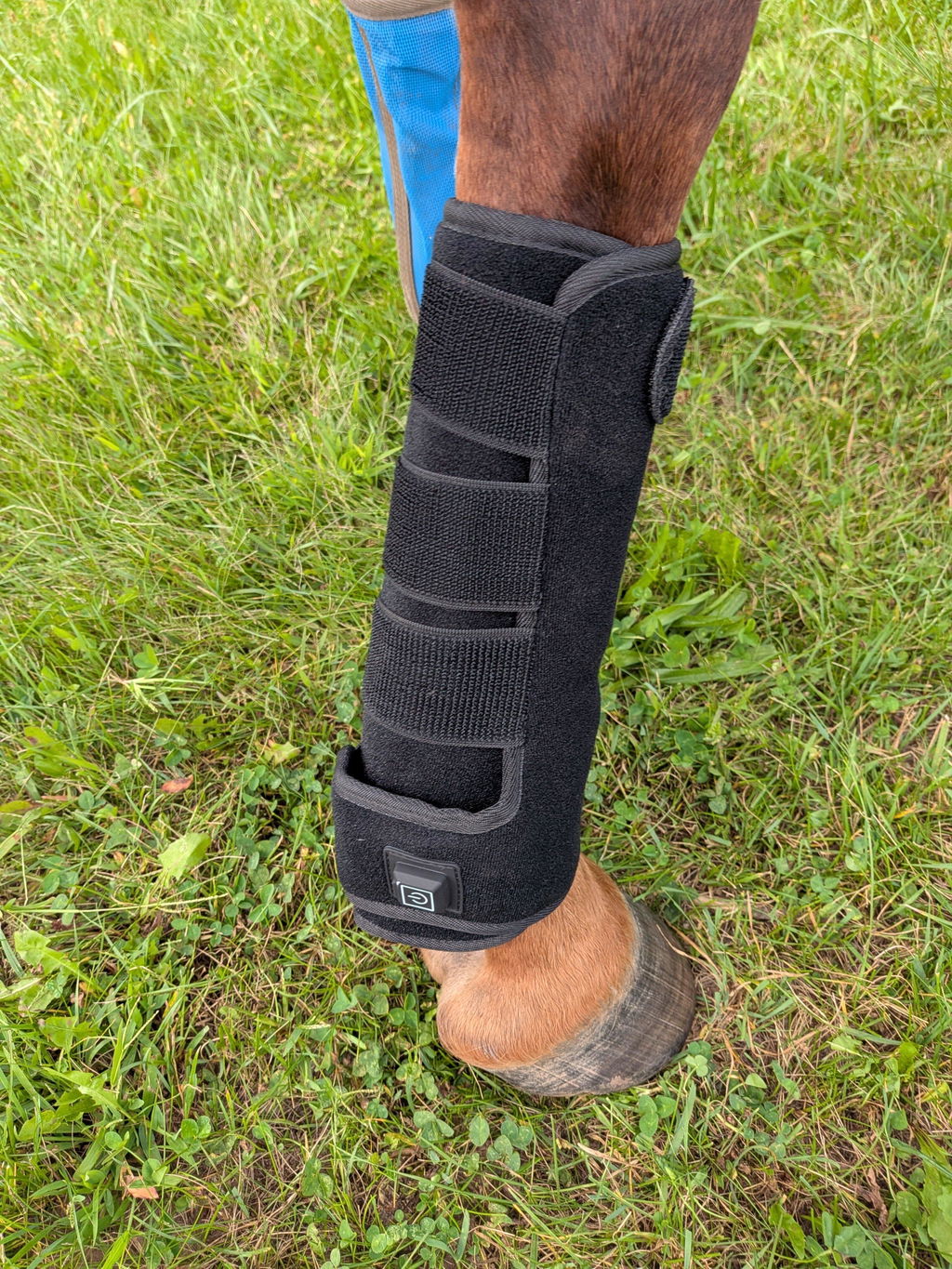
ACTIVE Hoof LED Light Therapy Pad
Charging, fitting, light modes and care instructions
Please read this entire guide before using the hoof boot. Keep it available for future reference.
Important safety information
- Never leave your horse unattended. Use only when the horse can stand calmly and safely.
- Introduce the boot gradually, especially if your horse is sensitive to hoof handling. Stop and remove it safely if the horse lifts the leg repeatedly, kicks or becomes distressed.
- Never look directly at the LEDs. Near-infrared LEDs may be operating even when they appear unlit.
- The LEDs may become warm. Check the hoof and surrounding skin for discomfort or irritation.
- Do not sharply fold, crush or damage the LED area or electrical components.
- Do not use a damaged boot or charging cable, and never immerse the boot in water.
- Do not operate while charging. Fully charge before first use.
The boot automatically switches off after 15 minutes. This device does not replace veterinary examination or treatment for hoof pain, lameness, infection or other medical concerns.
What’s included
- 1 × SV Equine Therapy ACTIVE Hoof LED Therapy Boot
- 1 × USB charging cable
- 1 × Drawstring storage bag
- 1 × User manual
Package contents are based on the supplied manufacturer brochure.
Charge before use
- Switch the hoof boot off and locate the USB Type-C charging port.
- Connect the supplied USB cable to a compatible USB power source.
- Allow the built-in rechargeable battery to charge. Disconnect the cable before fitting the boot to your horse.
- If the light output becomes noticeably dim, recharge before the next session.
Fit and start a session
- Prepare your horse. Choose a calm, safe location with secure footing. Clean and dry the hoof and the surrounding area.
- Position the boot while off. Fit it comfortably over the intended hoof area without excessive pressure. Avoid restricting circulation or natural movement.
- Switch on. Press the power button briefly to select the standard light mode; the indicator illuminates green.
- Choose a setting. Use the button sequence described below. Stay with your horse and monitor its comfort.
- Finish safely. The LEDs turn off automatically after 15 minutes. Switch off and remove the boot carefully before cleaning or storing.
Light settings
Continuous mode · Green indicator
Press the power button briefly to cycle through:
- Red and near-infrared LEDs together
- Red LEDs only
- Near-infrared LEDs only
- All LEDs off
Pulse mode · Blue indicator
With the device off, hold the power button for more than 3 seconds until the indicator turns blue. Press briefly to cycle through:
- Red and near-infrared LEDs pulsing together
- Red LEDs pulsing only
- Near-infrared LEDs pulsing only
- All LEDs off
Session duration and frequency
The ACTIVE Hoof boot has an automatic 15-minute timer.
The manufacturer brochure suggests 1–2 sessions daily for at least one week. This is general manufacturer guidance, not a veterinary treatment prescription. Introduce the boot with shorter supervised sessions as needed for your horse’s comfort.
For a suspected abscess, laminitis, infection, open wound, persistent lameness or swelling, consult your veterinarian or farrier as appropriate. Do not delay necessary hoof care.
Cleaning, care and storage
- Switch off and disconnect the charging cable before cleaning.
- Wipe the LED-facing/PVC area gently with a lightly damp cloth. Use a damp cloth or lint roller on fabric areas.
- Do not immerse, machine wash, saturate the electrical components or use harsh cleaning products.
- Allow the boot to air-dry completely before charging or storing.
- Store loosely arranged in its drawstring bag, away from direct sunlight and heat. Avoid sharp folds.
- Store in a clean, dry location above 5°C (41°F).
Technical specifications
View ACTIVE Hoof specifications
| Rated power (brochure) | 40 W |
| Charging port | USB Type-C |
| Operating modes | Continuous and pulse |
| LED quantity | 80 × 0.5 W LEDs |
| Wavelengths | 660 nm red; 850 nm near-infrared |
| Battery | Built-in rechargeable 1,800 mAh |
| Automatic timer | 15 minutes |
| Material | Fabric hoof boot |
| EMF (brochure) | 0 µT |
| Irradiance (brochure) | 150 mW/cm² at 0 inches |
| Intended application | Equine hoof area, with supervision |
Specifications reproduce the supplied manufacturer brochure and have not been independently verified. Rated power and irradiance are manufacturer-reported values.
Troubleshooting
The boot does not turn on
The red LEDs appear to be off
The LEDs switch off after 15 minutes
The lights appear dim
My horse reacts to the boot
Understanding the two wavelengths
660 nm red light is visible, while 850 nm near-infrared light is generally invisible to the human eye. These wavelengths are used in photobiomodulation devices, but evidence for specific equine hoof conditions is limited. The boot is not a substitute for veterinary treatment.